Designing the role of AI in vehicle reservation
Timeline
3 months
Device
Desktop, Tablet, Mobile



Impact
1
Scalable AI experience system
Created reusable interaction patterns and guardrails, establishing a scalable AI design system while adapting the experience to the unique requirements of our product flow.
100%
Designed for human escalation
Intentionally included human support as a core fallback, ensuring a clear path to dealer contact when the assistant cannot resolve their needs.
0 -> 1
Clear AI boundaries
Established what the assistant should and should not handle, particularly around personal and sensitive questions.
Context
How it started…
This project began as an internal hackathon idea: a simple FAQ-based AI assistant embedded in the Checkout flow.
When I took over the initiative, the goal was to evolve this early concept into a validated product direction by testing it with users, refining the types of questions the assistant should handle, and aligning it with existing AI patterns across related products to ensure consistency across the journey.
Hackathon concept
Problem
AI can answer a question. But can it earn enough trust to help someone reserve a car?
Previous research revealed four barriers to making AI useful in the reservation journey: hard to discover, hard to trust, hard to know when to use, and hard to recover from.
This created a bigger challenge than simply building a better chatbot. How might AI support the reservation journey without adding another layer of friction?
Hard to discover
Users often didn’t notice the assistant, or didn’t know what they could ask it.
“
It was kind of just hidden away, it wasn’t as obvious.
”
Hard to know when to use
Users expected AI to behave like a conventional FAQ, rather than understanding its potential as an agentic assistant.
“
I would use this feature purely on the basis of a simplified FAQ.
”
Hard to recover from
When AI couldn’t answer, users needed a clear path to human support rather than being left at a dead end.
“
I would like it if it could still direct me to a human being if required.
”
Process
From early on, I aligned closely with cross-product teams, building on their existing AI chatbot pattern. Rather than introducing a completely new system, I focused on evolving what already existed by ensuring consistency across the AI ecosystem while improving clarity within the reservation context.
Influenceing to AI Governance
Cross-product different versioning
Check-in with Design System team


Full width layer -> suggested side panel

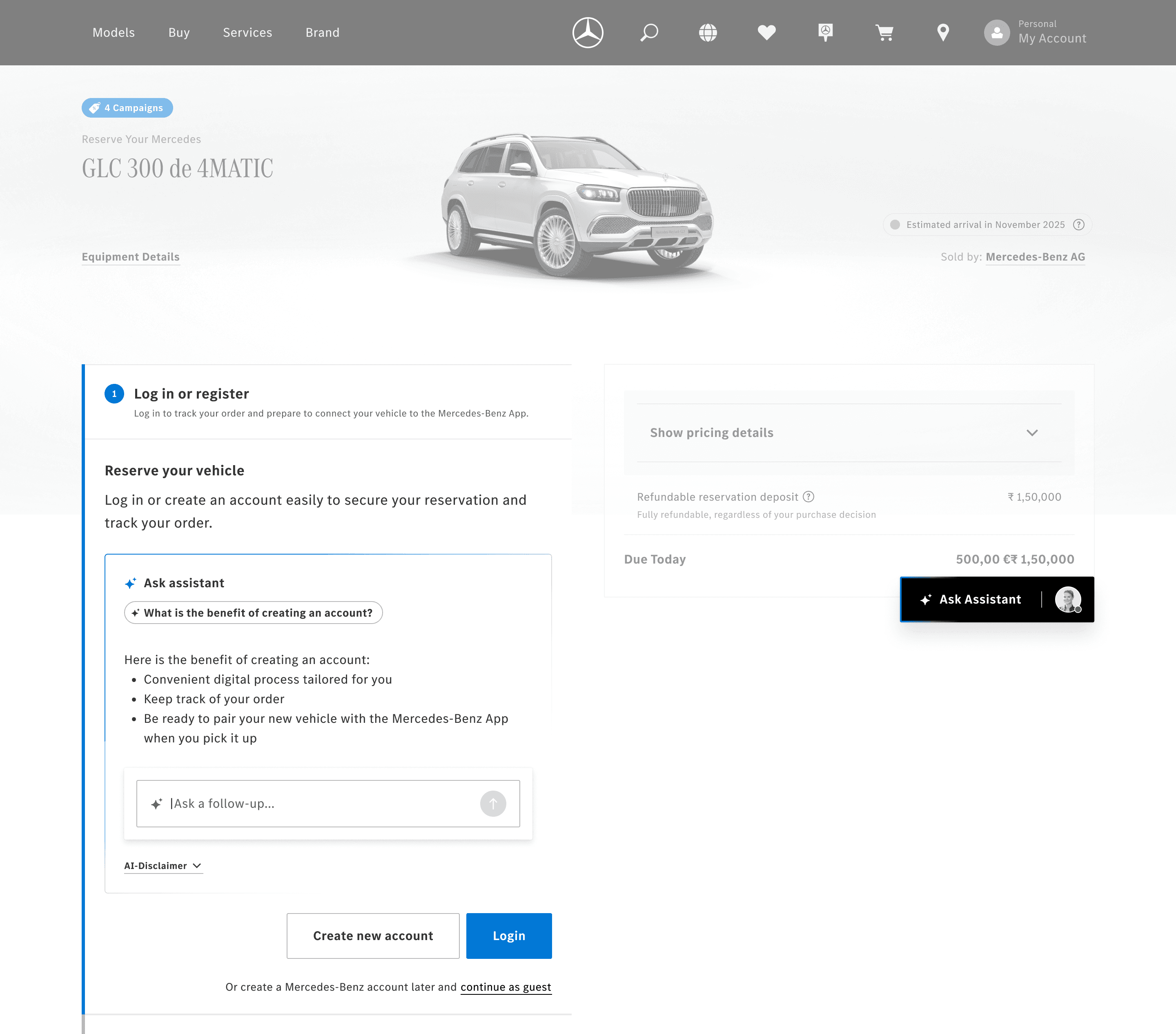
I iterated an interaction model that allows users to move fluidly between UI, contextual help, and conversation depending on intent and complexity.


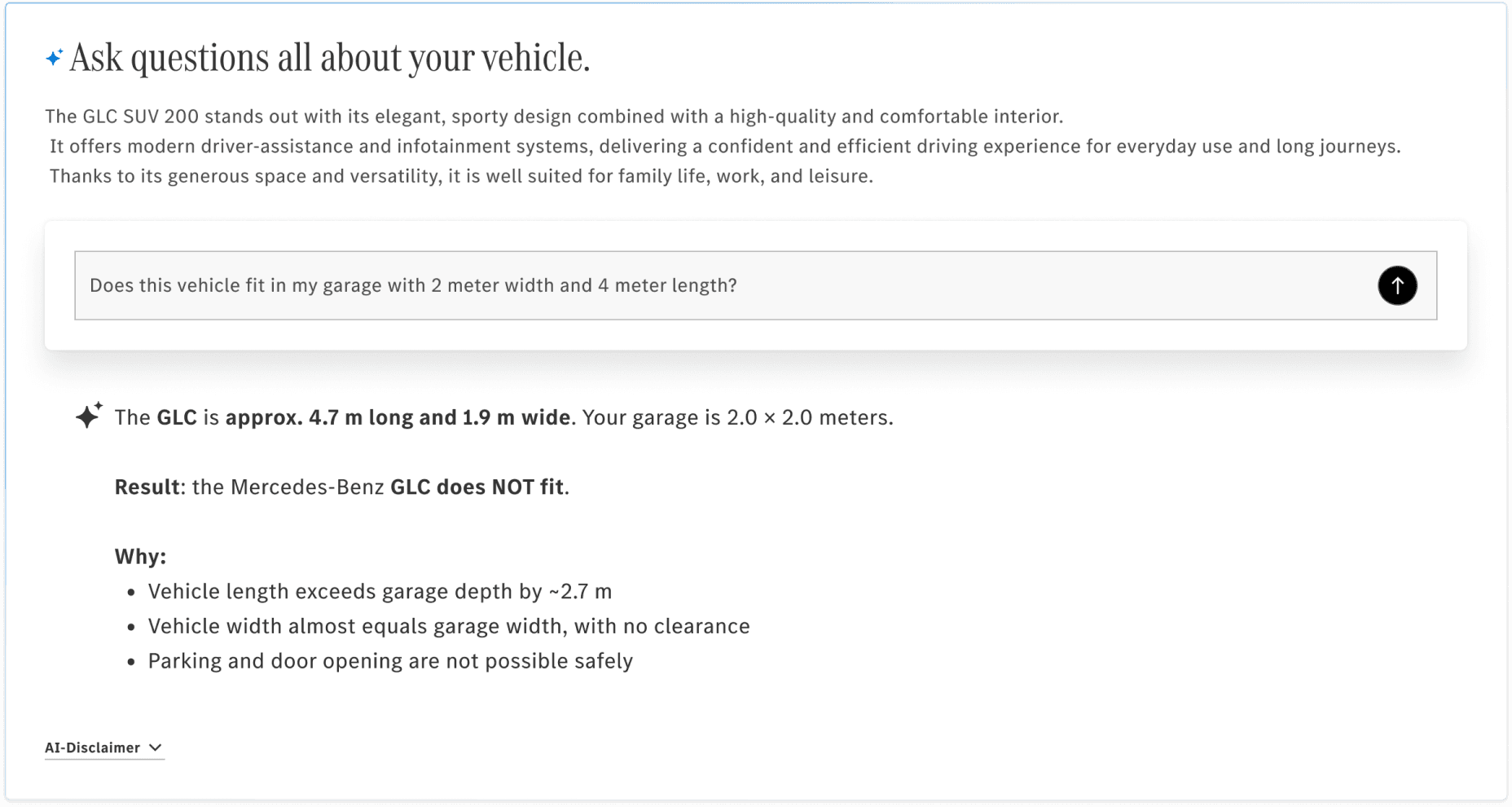
Finally, I established clear behavioral boundaries and translated the system by defining when it should hand off to a human, and how it should behave when it reaches its limits.
These refinements turned into scalable patterns and guardrails that could allow market-specific adaptation without losing the blueprint.


Solution
Start with the question, not the chat.
Instead of asking users to figure out what to ask, I refined contextual AI prompts coming from previous user tests based on confusions and frequently asked questions.
The assistant could surface relevant questions based on where users are at in the reservation steps, helping customers understand what AI can do while reducing the effort required to start a conversation.
How will my data be used?
“
For some fields, participants expect short explanations why this kind of information should be provided (e.g. to clarify questions, for marketing…)
User test summary
”
An assistant that adapts to user intent and contextual needs
To support different levels of intent while maintaining checkout continuity, I designed a responsive AI panel system.
On desktop, I chose a side panel approach so users can access AI support without losing visibility of the reservation flow. This allows the assistant to feel present but non-intrusive, supporting quick reference while keeping the main task in focus.
On mobile, I explored a mid-panel layout as the default interaction pattern. Despite the limited screen size, users have enough space for the answers they are looking for without fully breaking away from the reservation context.
In cases where a deeper conversation is needed, it can expand into a full-screen, allowing the assistant to become the primary focus.
Build trust through boundaries.
A reservation assistant should not try to answer everything.
When the assistant reaches its limits, the experience should acknowledge this and guide customers to the right next step, including human dealer support.
The goal was not to make AI the only support channel, but to make AI a useful first layer of support with a human fallback when confidence matters most.
“
I would like it if it could still direct me to a human being if required.
User test participant
”
Human-in-the-loop
Reflections
Alignment in evolving topic requires intentional trade-offs.
Versioning became a challenge when different product teams were shipping at different stages of the product journey.
We learned to prioritize alignment over short term consistency, allowing live products to inform future AI patterns while emerging direction shaped products over time. In an evolving system, consistency became an ongoing practice, not a fixed outcome.
Human fallback is part of AI design.
Designing an AI experience doesn't mean removing humans from the journey.
When users are making consequential decisions, the ability to reach a person is itself a trust signal. For this reason, human escalation isn't an exception to the AI experience, it is part of it.
If I had more time…
Continuity across the reservation journey
I would take the design further toward a context-aware reservation assistant that can maintain continuity across the journey, understand where the customer is in the reservation process, and provide increasingly personalized support while respecting clear boundaries around sensitive information.